The Digital Dissolution of Disegno
Michael Graves — the architect behind the Portland Public Service Building, which could be considered the emblem of Fredric Jameson’s notion of pastiche — recently published an opinion piece in the New York Times entitled “Architecture and the Lost Art of Drawing.” “What has happened,” Graves asks, ”to our profession, and our art, to cause the supposed end of our most powerful means of conceptualizing and representing architecture?” That which is threatened, in Graves’ view, is the drawing and that which is threatening it is “computer-aided design software with names like AutoCAD and Revit, a tool for ‘building information modeling.’”1
As a discipline architecture has always, as other disciplines within the realm of representation, rested heavily on the deployment of technologicies and to an equal degree, with a few historical exceptions, on the notion of authorship. The discipline’s mathematical and geometrical essence is inscribed in it by means of its tools — the draft ing machine, the scale ruler, orthographic projection, the velo, or the computer. At first, therefore, it is hard not to dismiss this claim of loss as merely the conservative, perhaps even reactionary, outburst of an architect who sees his prime tool of representation being outdated and outgunned — a generational shift that also entails a transition of power.
Marshall McLuhan’s analysis of the mechanism of tribalization in regard to the advent of new technologies and/or media seems to fit Graves’ critique exactly: “Specialist technologies detribalize. The nonspecialist electric technology retribalizes. The process of upset resulting from a new distribution of skills is accompanied by much culture lag in which people feel compelled to look at new situations as if they were old ones”.2
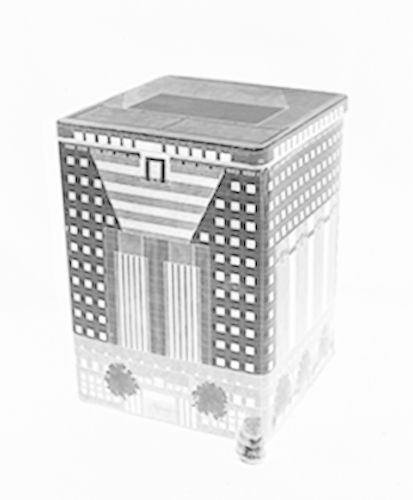
Bildtext: Michael Graves, Portland (Municipal Services) Building opened and dedicated on October 2, 1982. Altered.
However if Graves’ stance is seen as just another avantgarde vs. avant-garde battle, as a kind of naive prolongation of Heidegger’s “authentically acting hand,” as an “obstinate Luddism”3, of the consequences of what is now often called the digital turn in architecture are lost. That turn entails, it could be argued, a shift from technique to technology within architecture in a more fundamental way than earlier technological deployments hitherto had.
A paradigmatic shift evident in Graves’ comment that “[b]uildings are no longer just designed visually and spatially; they are ‘computed’ via interconnected databases” — that is, in a new way of design that implies an opaqueness of authorship (and agency) that will, whether one affirms it or not, transform the authoritarian art of architecture. Understood in this way, Graves’ somewhat alarmist and bitter critique of computer-aided design tools might also help to bring to fore a set of underlying and constitutive concepts advocated by both the propellants of the drawing and the digital.
The Divinity of Design
In The Alphabet and the Algorithm, Mario Carpo demonstrates convincingly the extent to which architecture since Alberti has considered the design of a building as the original and the building as its copy.4 A copy, it might be added, that, at least up until now, has been bound to be imperfect. Counter-intuitively given that we often think of architecture as buildings with mass that occupy space, architecture as a discipline, at least since the renaissance, is one of the most Platonic of the arts and is so by means of its claim of drawing over building. However, this Platonism must also be understood in relation to its mediation.5
It is worth noting how both the “drawing over building” hierarchy and the “projective inscription” could, and perhaps should, be understood in relation, and translated, to the distinction and rivalry, between disegno and colore. The sixteenth century debate stood primarily over the value of painting being that of the idea (invenzione) with its origin in the mind of the artist materializing through disegno, defined by Lodovico Dolce as “the form with which the painter presents his material”6, colore, on the other hand, represented the more lively diversity of nature through variation and color materializing through the act of painting (rather than drawing). In the words of Federico Zuccari (1542– 1609) disegno “is not matter, not body, nor affection, nor substance, it is a form, idea, rule boundary, or the object of the mind.”7
However ideal these qualities might seem, disegno is not confined to the mind, but may just as well be a drawing on a paper — disegno extends from the internal to the external as Zuccari makes a distinction between disegno interno and disegno esterno.8 “One should remember,” Zuccari writes, ”that there exist two kinds of operations: external ones like drawing, outlining, shaping, carving, building [disgno esterno], and internal ones like reasoning and desiring [disegno interno].”9 Disegno interno, he argues further, is an “example and shadow of the divine,” a “spark of divinity” common to all men. The manifestations of disegno esterno — though exemplified by drawing, outlining and shaping — is not to be regarded a completed work of art as the “external design is nothing but that which is circumscribed by form without corporeal substance.”10 The ambiguities and peculiarities of disegno, relating to the distinction between original and the copy in the Albertian sense and between disegno interno and disegno esterno, not only haunt Quattrocento accounts but are implicit in contemporary discussion on drawing versus digital.
Bildtext: Rhino wireframe sketch augmented with generic Photoshop filter. Altered.
There is however not just one digital turn in architecture but two. Already towards the end of the first coming — with its origin dating back as early as 1963 with the development of the first CAD (Computer Aided Design) program11 — Nicholas Negroponte in 1969, in his discussion of the architectural machine, highlights some implications of the digital turn that holds true also for its second coming:
When a designer supplies a machine with step-by-step instructions for solving a specific problem, the resulting solution is unquestionably attributed to the designer’s ingenuity and labors. As soon as the designer furnishes the machine with instructions for finding a method of solution, the authorship of the results becomes ambiguous. Whenever a mechanism is equipped with a processor capable of finding a method of finding a method of solution, the authorship of the answer probably belongs to the machine.12
From Design to Drawing to Diagram to Digital
In their highly influential text, “Notes Around the Doppler Effect” (2002), Robert Somol and Sarah Whiting address the topos of engagement and autonomy. Their discussion critiques K. Michael Hays’ view of critical architecture as a position “between culture and form,” asserting the (im)possibility of such a position. Now a decade old, Somol and Whiting’s text has gained both critique and endorsement in a way only a few texts of its kind have. Together with Michael Speaks’ “Design Intelligence," “Notes Around the Doppler Effect” has become seminal to what is known as the post-critical stance in architectural discourse that opposed the possibility of criticality in both architectural design and discourse. A stance that in the words of George Baird considers the critical ”as obsolete, as irrelevant, and/or as inhibiting design creativity.”13
The inhibiting force of critique for Somol and Whiting lies in Hays’ view that critical architecture is something between culture and form: “The proposition of a critical realm between culture and form is not so much an extension of received views of interpretation as it is a challenge to those views that claim to exhaust architectural meaning in considerations of only one side or the other.”14 Thus Hays’ position is oppositional: first to positions that “emphasize culture as the cause and content of built form; [where] the task of the interpreter, then, becomes the study of objects and instruments of cultural values”; second, to the idea of “Architecture as autonomous form,” which begins “with the assumption that the only alternative to a strict, factual recovery of the originating situation is the renunciation of a single ‘truth,’ and advocates a proliferation of interpretations based solely on form.”15 Hays closes his description of the position-in-between by concluding that: “If critical architectural design is resistant and oppositional, then architectural criticism — as activity and knowledge– should be openly contentious and oppositional, as well.”16
While the Haysian betweenness could be regarded as a position of both/and, Whiting and Somol articulate yet another position in terms of a neither/nor. This position, they argue, would allow for an escape from the impossibilities of the critical past by evoking the diagram.17 The diagram “‘imposes a particular form of conduct on a particular multiplicity.’”18 and should also be understood as a means of “investigation of the frame structure” (a reference to Rem Koolhaas’ project the Downtown Athletic Club). To Somol and Whiting, this opens for a distinction between the critical and the projective, where the latter “’proceeds through the diagram’”19.
As Hélène Frichot has noted in ”Drawing, Thinking, Doing: From diagram work to the superfold,” “Although there is no explicit mention by Somol of emerging digital architec tures, I would argue” — and I agree — ”that these new technologies are part of what have contributed to the shift that Somol identifies between drawing and diagramming.”20 The implications of this were first laid out in the “Folding in Architecture" issue of Architectural Design from 1993. In the opening text, symptomatically titled “Unfolding Folding,” Kenneth Powell cites Mark Wigley referring to deconstructive architecture as “‘devious’ and ‘slippery’ — and disturbing […] It had to disturb, to be subversive, in order to break the hold of the old order.”21 “In practice,” Powell continues, “architecture cannot be engaged in a process of permanent revolution, it has practical and formal as well as speculative and philosophical [sic.] ends to pursue.”22
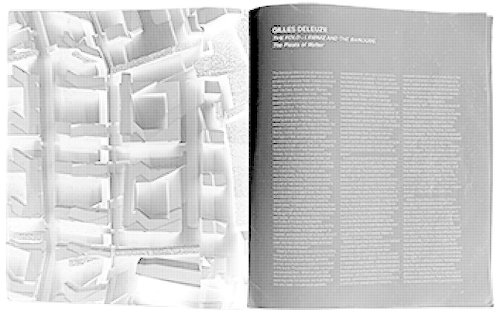
Bildtext: Spread from “Folding in Architecture” (Architectural Design, 1993). Altered.
In elaborating on the proposed generative side of the diagram Somol and Whiting also make use of Marshall McLu han’s distinction between “Media Hot and Cold”:
There is a basic principle that distinguishes a hot medium like radio from a cool one like the telephone, or a hot medium like the movie from a cool one like TV. A hot medium is one that extends one single sense in “high definition”. High definition is the state of being well filled with data. A photograph is, visually, “high definition.” […] Telephone is a cool medium, or one of low definition, because the ear is given a meager amount of information.23
Considering the diagram a cool media, in combination with their understanding of the productive side of the diagrammatic, Somol and Whiting argue for its ability to open up the architectural discipline. In their critique of the hitherto dominant and critical stance in architectural discourse Somol and Whiting conclude that:
One could say that their definition of disciplinarity is directed against reification rather than toward the possibility of emergence. While reification concerns itself with the negative reduction of qualitative experience to quantification, emergence promises that serial accumulation may itself result in the production of new qualities. As an alternative to the critical project — here linked to the indexical, the dialectical and hot representation — this text develops an alternative genealogy of the projective — linked to the diagrammatic, the atmospheric and cool performance.24
The implications of Somol and Whitings text can be unfolded and act as a lens through which to see how the changes that occurred during the second digital turn were indeed fundamental and discipline changing. In Macluhan’s terms Somol and Whitings claim that theirs is a “cool” rather than a “hot” methodology can and should be disputed as their argument rests heavily on this distinction.
Following McLuhan the question is if it really is the “indexical and the dialectical” that we are to understand as a reifying force? Following how Fredric Jameson in the afterword to Aesthetics and Politics describes reification as “a process that affects our cognitive relationship with the social totality,” a process that, “renders society opaque”25 is it not rather the “diagrammatic and atmo spheric” that should be understood in terms of reification? In the diagrammatic and atmospheric lays an all-encompassing idea of architecture that extends beyond the avant-garde’s will to gain ground to the furthering of the discipline. A will that is present already in Robert Somol’s “Dummy Text, or The Diagrammatic Basis of Contemporary Architecture”:
Working diagrammatically — not to be confused with simply working with diagrams — implies a particular orientation, one which displays at once both a social and a disciplinary project. And it enacts this possibility not by representing a particular condition, but by subverting dominant oppositions and hierarchies currently constitutive of the discourse.26
With McLuhan I would argue that the claim of a ubiquitous atmospheric quality expressed in the orientation towards both a social and disciplinary projecthood should be understood in terms of a hot medium rather than a cool. Hence, in contrast to Somol and Whiting’s “alternative genealogy of the projective,” I would like to suggest that rather than to understand the projective, the atmospheric and the diagrammatic as emergence, it should be understood in terms of reification. That the notion of atmosphere can be attached to an idea of reification — of providing the controlling means for the realisation of things — is evident in Mark Fishers understanding of capitalist realism: “It is more like a pervasive atmosphere, conditioning not only the production of culture but also the regulation of work and education, and acting as a kind of invisible barrier constraining thought and action.”27 For what are the atmospheric workings of the diagrammatic — that which “‘imposes a particular form of conduct on a particular multiplicity’” — if not reification in the Jamesonian sense described above? Perhaps then the projective stand should simply be regarded as yet another ideological mystification of the workings of late capitalism.
In “Dummy Text” Somol also argues that “In general, the fundamental technique and procedure of architectural knowledge has seemingly shifted, over the second half of the twentieth century, from the drawing to the diagram.”28 But how are we to understand this shift from drawing to diagram? Is Somol here thinking of the drawing as something like the diagram also in its diagrammatic sense or is he reducing the diagram to a form of representation? In the latter case with McLuhan one could argue that yes, if the diagram is to be understood in the sense of a two-dimensional representation of a process or an account of data etcetera it surely is to be understood as a cold medium, just as the low definition drawing is. However this is not the kind of diagram Somol (and Whiting) are thinking about, rather it is, as noted above, a diagram which “imposes a particular form of conduct on a particular multiplicity". This “imposition of a particular form of conduct on a particular multiplicity requires” — even as it rests on the historical working of disegno interno and disegno esterno — a new interface that is not to be reduced only to a simple “graphical user interface” but also must be understood as a more fundamental disposition of society as a whole.
To unfold this, it is necessary to look into the technoscientific ideological framework mentioned above, that is the relation between society, science, and technology in connection to Max Weber’s understanding of rationalization as a “purposive-rational action” that “aims at the establishment, improvement, or expansion of systems of purposive-rational action themselves.”29 In discussing Herbert Marcuse’s view of the concept of rationalization, Jürgen Habermas concludes that to Marcuse “what Weber called ‘rationalization’ realizes not rationality as such but rather, in the name of rationality, a specific form of unacknowledged political domination.”30 Aiming at establishing, improving, and expanding a system of purposive-rational action — constructing an “evolutionary system” — we can see how Nicholas Negroponte’s architecture machine fit well into such a framework:
This discussion is not about machines that necessarily can do architecture; it is a preface to machines that can learn about architecture and perhaps even learn about learning about architecture. Let us call such machines architecture machines; the partnership of an architect with such a device is a dialogue between two intelligent systems — the man and the machine — which are capable of producing an evolutionary system.31
If technology and science are to be understood as ideology in the sense proposed above we can also see how this ideology acts as a vanishing mediator, just as Protestantism to Weber once served as the mediator between the medieval and modern (capitalist) world that later withdrew its defining properties and remained unacknowledged. This phenomenon could also explain the temporal discrepancy that constitutes the first and second digital turn in architecture. As Slavoj Žižek has shown, in a dialectical process, form stays behind content as ”the crucial shift occurs within the limits of the old form” until the work is done and the old form can fall off.32 The process of rationalization — that both instills a new cognitive order and destroys old forms of legitimizing processes — will also give rise to the science of architecture expressed for instance in the will to supersede the old legitimation found in the humanistic and/or anthropomorphic, toward the post-human, projective, performative, and biomimetic.
It is hard not to understand this development in relation to Heidegger’s concept of enframing (Ge-Stell) that, in the words of Sven-Olov Wallenstein, should be understood “as a systemic, auto-regulating, and totalizing quality.”33 Neither is it hard to find in Negroponte’s ideological architecture machine an affinity and close relationship to another form of machine, the abstract machine described by Delueze and Guattari as follows:
it is the reinvention of a machine of which human beings are constituent parts, instead of subjected workers or users. If motorized machines constituted the second age of the technical machine, cybernetic and informational machines form a third age that reconstructs a generalized regime of subjection: recur rent and reversible “humans-machines systems” replace the old nonrecurrent and nonreversible relations of subjection between the two elements; the relation between human and machine is based on internal, mutual communication, and no longer on usage or action.34
It is important to stress here that recurrent and reversible cybernetic and informational machines, freed from usage or action, continue to produce an evolutionary system, just as in Negroponte’s architecture machine. The “dialogue between two intelligent systems” fully adheres to the “purposive-rational action” although this action is no longer — as in the second age of the technical machine — to be understood as man's domination over nature and man.
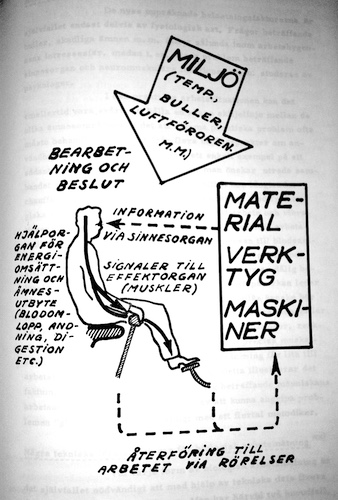
Bildtext: An example of dialogue between two presumably intelligent systems — the man and the machine. Diagram from Automationen ur teknisk och social synpunkt, Ingenjörsvetenskapsakademiens meddelande 130 (Stockholm: IVA, 1961).
The mutual constitution of, and the reciprocal relation between, the abstract and architecture machine is then a prerequisite of a certain paradigm described by Douglas Spencer as follows: “For many thinkers of the spatiality of contemporary capitalism, the production of all social space tends now to converge upon a single organizational paradigm designed to generate and service mobility, connectivity and flexibility.”35
Presumably in the background of Somol’s argument is the realisation that drafting in the architectural profession is gradually being superseded by computer aided design and a whole promising raft of new modelling and animation soft wares.36 It seems as if the diagrammatic and digital turns have in common both a notion of a “total situation,” and the concern with effect (and affect) over meaning. A phenomenon that McLuhan identifies with hot media: “Concern with effect rather than meaning is a basic change of our electric time, for effect involves the total situation, and not a single level of information.”37 The “hot representations” of the previous avant-garde that the “projectives” seek to overcome is present also in the diagram matic, however not in the same representational way. Instead it is manifest by way of the immersive “hotness” of the mathematical/geometrical ontology in Deleuze’s reading of the Baroque. As Mario Carpo has put it:
Owing to a bizarre series of events that is still to be reconstructed, Deleuze’s pli, when exported to Amer ica, morphed into the Deleuzian Fold and merged with the visualization of Leibniz’s differential calculus that computers now made available to most architects, regardless of their mathematical talents. As a result, algorithmically generated continuous functions soon became an almost ubiquitous component of architectural design.38
One of the most prolific examples of the relation between the diagrammatical and the digital turn is the objectile, the name Gilles Deleuze gave to the research done by Bernard Cache into how to industrially produce nonstandard objects. In The Fold Deleuze writes:
As Bernard Cache has demonstrated, this is a very modern conception of the technological object: it refers neither to the beginnings of the industrial era nor to the idea of the standard that still upheld a semblance of essence and imposed a law of constancy (”the object produced by and for the masses”), but to our current state of things, where fluctuation of the norm replaces the permanence of a law; where the object assumes a place in a continuum by variation; where industrial automation or serial machineries replace stamped forms. The new status of the object no longer refers its condition to a spatial mold — in other words, to a relation of form-matter — but to a temporal modulation that implies as much the beginnings of a continuous variation of matter as a continuous development of form.39
The affirmation of the “current state of things” that lays in the neither/nor can of course be considered as an emergence of something radically new. However it can also be seen as a defense of status quo by the internal or immanent forces of the abstract machine expressed through the workings of the architecture machine and its production of an ”evolutionary system”.
Rendering the Real
There is a global convergence in recent avant-garde architecture that justifies the enunciation of a new style: Parametricism. The style is rooted in digital animation techniques. Its latest refinements are based on advanced parametric design systems and scripting techniques. This style has been developed over the last 15 years and is now claiming hegemony within avant-garde architecture. It succeeds modernism as a new long wave of systematic innovation. The style finally closes the transitional period of uncertainty that was engendered by the crisis of modernism and that was marked by a series of short lived episodes including Postmodernism, Deconstructivism, and Minimalism.40
Owing its existence to the digital turn of the 1990s parametricism has over the last half decade or so been raised to stardom, mostly through the advocacy of Patrik Schumacher. As the quote above suggests, the claims of the parametric avantgarde are far-reaching. Describing his 2011 book The Autopoiesis of Architecture as “an attempt to create a comprehensive and unified theory of architecture" Schumacher — in the same lecture, held at SCI Arc in September 2010 — also argues: “Parametricism continues the autopoesis of architecture, which is the self-referential, closed system of communications that constitutes architecture as a discourse in contemporary society.”41 To Schumacher it seems then as if the unified theory of parametricism is not only to become the savior of the discipline of architecture but also to reinstate its autonomy. An autonomy, that is, that does not recognize the authority of politics, clients, science or morality but is “the autonomy to adapt to an environment and to stay relevant in it,”42 an autonomy that is of social resilience.
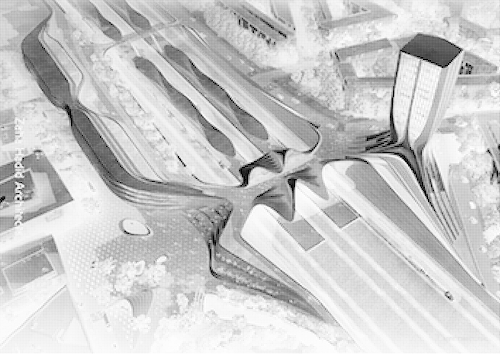
Bildtext: Zaha Hadid Architects, proposal of a remaking of the station area in Upplands Väsby (Stockholm region). Copyright Zaha Hadid Architects. Altered.
So how are we to understand the seemingly contingent but still defining and authoritative environment Schumacher refers to in his creed for autonomy? This question becomes even more acute since the construction of such an aesthetic ideology is in line with what Martin Jay, with a sense of despair, refers to as a “l’art pour l’art tradition of differentiating a realm called art from those of other human pursuits, cognitive, religious, ethical, economic, or whatever.”43 How to address and confront an aesthetic ideology strengthened by its techno-scientific claims in a post-political society permeated by a cybernetic telos of progress as a means to counter organic and inorganic entropy?
As yet another result of the effects and affects44 of the diagrammatic digital turn of the 1990s it seems as architecture, at least as it is understood by the propellants of the projective and later the parametric, has turned into a form of “image-building”. As Hal Foster has noted with regards to the global style of contemporary architecture it is characterized by its “‘banal cosmopolitanism’,” that implies that, “even as its signal buildings respond to local conditions and global demands at once, they often do so in a manner that produces an image of the local for circulation to the global.”45 With this turn to the image some rather remarkable transformations have occurred in terms of the relation between concept and representation. Not only, as Peter Eisenman recently stated in an interview, is the digital “inhabited by what I call the phenomenological, or the thought of materials in a nostalgic and romantic way” but it also seems to take advantage of the implosion of disegno and colore into inventione by means of the digi tal, allowed as a result of the collapse of the representational in the wake of the diagrammatic and digital upheaval of interior and exterior.
A stark contemporary example of this has been brought to fore by John Hill in the August 2012 issue of the journal Clog (“Rendering”) where he shows how the office Allied Works Architecture (AWA) chooses to present their work on The Museum of Arts and Design in New York, not in concordance with how it was built but how it was designed. This is neither something new nor extraordinary in terms of how architects traditionally have understood the final work. However, as we shall see, AWA’s presentation fundamentally differs in the way in which it carries out the task of showing the work. In one of the photos presenting the project a part of the façade has been fundamentally altered in Photoshop in order for the representation to manifest the disegno rather than building as built.
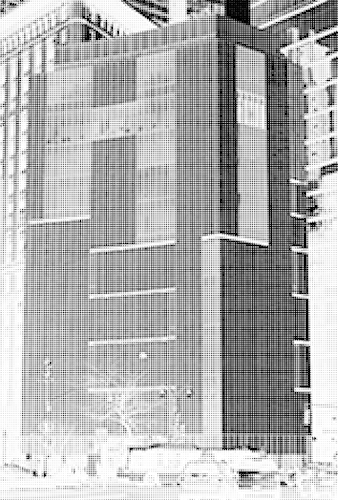
Bildtext: The Museum of Arts and Design at 2 Columbus Circle in Manhattan, New York City. Photo: Beyond My Ken. Source: Wikimedia. Altered.
But why at all claim the mimetic force of the photographic image in order to represent the project, if the realized project does not represent the disegno? It seems as if the two visual regimes of disegno and colore have collapsed into each other through the mediation of the possibilities rendered by advanced digital technologies and architecture machines of the early twentyfirst century. This also implies a reversal or even upheaval of Zucchari’s diagram as this rested on the idea of difference and “mechanisms of projection”. When “the relation between human and machine is based on internal, mutual communication, and no longer on usage or action”46 the distance necessary to critique has dissolved. As a paradox it also seems as the disciplinary credo of both the projectives and paramatrecists renders authorship obsolete or at least contingent. With the totalizing claims expressed in the idea of Schumacher’s “unified theory of architecture" in synthesis with the “social and a disciplinary project” of Somol and Whiting made possible by the technologies of late capitalism — and as a technology of late capitalism — the withdrawal of authorship and agency and with it the possibility of responsibility is, to say the least, worrying in its implications to both the disciplinary and the social.
Somol and Whiting end “Notes Around the Doppler Effect” by concluding that the projective program “does not necessarily entail a capitulation to market forces, but actually respects or reorganizes multiple economies, ecologies, information systems, and social groups.”47 To a certain extent, this is obviously true: the projective and parametricist programs do not entail a capitulation to market forces but rather are a prerequisite for them.
-
Michael Graves, “Architecture and the Lost Art of Drawing,” New York Times, September 1, 2012, accessed February 12, 2013, www.nytimes. com/2012/09/02/opinion/sunday/architec ture-and-the-lost-art-of-drawing. html?_r=5\&pagewanted=all&. ↩
-
Marshall McLuhan, Understanding Media (New York: Routledge Classics, 2001), 26–7. ↩
-
Pablo Miranda Carranza, “Out of Control: The Media of Architecture, Cybernetics and Design,” in Material Matters Architecture and Material Practice, ed. Katie Lloyd Thomas (Oxon: Routledge, 2007), 152. “Besides unconditional acceptance and consumption of these new ‘tools’, or otherwise an obstinate Luddism — praiseworthy, perhaps, in its critical resistance but not all that practical in the face of contemporary CAD dominance — there is a need to look at the longer-term effects of the use of computation in architecture and at the relation between architects and their technologies.” ↩
-
Mario Carpo, The Alphabet and the Algoritm (Cambridge: The MIT Press, 2011), 26. ↩
-
As Pablo Miranda Carranza has noted in “Out of Control: The Media of Architecture, Cybernetics and Design,” 153: ”Through an almost literal implementation of the archetypical Platonic allegory of the cave, the mechanisms of projection inscribe Platonic discourse into the technologies and media of architecture.” ↩
-
See Jane Turner, The Dictionary of Art, Vol. 9 (New York: Grove, 2006), 6. ↩
-
Federico Zuccari, cited in Moshe Barasch, Theories of Art: From Plato to Winckelmann (New York: Routledge, 200), 299. ↩
-
See Barasch, Theories of Art, 295ff. ↩
-
Barasch, Theories of Art, 299. ↩
-
Barasch, Theories of Art, 301. ↩
-
For a thorough account of this, see Pablo Miranda Carranza, “Out of Control: The Media of Architecture, Cybernetics and Design.” ↩
-
Nicholas Negroponte, ”Toward a Theory of Architecture Machines,” Journal of Architectural Education Vol. 23, No. 2 (Mar., 1969): 9.. ↩
-
George Baird George Baird, “Criticality and Its Discontents,” Harvard Design Magazine, No. 21, Fall 2004/Winter 2005: 1. ↩
-
K. Michael Hays, ”Between Culture and Form,” Perspecta Vol. 21 (1984): 15 ↩
-
Hays, ”Between Culture and Form,” 16. ↩
-
Hays, ”Between Culture and Form,” 27. ↩
-
As Hélène Frichot has pointed out the diagram — with direct reference to the diagrammatic workings of Deleuze and Guat tari’s abstract machine — by architectural thinkers and designers of the 1990s was considered ”as a generative tool to bring forth the possibility of new and ever-transforming built worlds.” See Hélène Frichot, ”Drawing, Thinking, Doing: From diagram work to the super fold,” ACCESS Critical Perspectives on Communication, Cultural & Policy Studies Volume 30(1) 2011: 2. ↩
-
Robert Somol and Sara Whiting, ”Notes Around the Doppler Effect,” in Constructing a New Agenda. Architectural Theory 1993–2009, ed A. Krista Sykes (New York: Princeton Architectural Press, 2011), 196. ↩
-
Somol and Whiting, ”Notes Around the Doppler Effect,” 196. ↩
-
Frichot, ”Drawing, Thinking, Doing,” 5. ↩
-
Kenneth Powell, ”Unfolding Folding,” Architectural Design, Profile 102 Folding in Architecture (London: Academy Editions, 1993) 7. ↩
-
Powell, ”Unfolding Folding,” 7. ↩
-
Marshall McLuhan, ”Media Hot and Cold,” in Understanding Media (New York: Routledge Classics, 2001), 24. ↩
-
Somol and Whiting, ”Notes Around the Doppler Effect,” 193. ↩
-
Fredric Jameson, ”Reflections in Conclusion,” in Aesthetics and Politics, (London: NLB, 1977), 212. ↩
-
Robert Somol, “Dummy Text, or The Diagrammatic Basis of Contemporary Architecture,” in Diagram Diaries ed. Peter Eisenman (New York: Universe, 1999), 23. ↩
-
Mark Fisher, Capitalist Realism. Is There No Alternative? (Winchester: Zero Books, 2009), 16. ↩
-
Somol, “Dummy Text,” 7. ↩
-
Jürgen Habermas, Toward A Rational Society, trans Jeremy J. Shapiro (Boston: Beacon Press: 1970), 81. ↩
-
Habermas, Toward A Rational Society, 82. ↩
-
Negroponte, ”Toward a Theory of Architectural Machines,” 12. ↩
-
Slavoj Žižek, For they Know Not What They Do: Enjoyment as a Political Factor (London: Verso, 2008), 185. ↩
-
Sven-Olov Wallenstein, Nihilism, Art, Technology (Stockholm: Axl Books, 2011), 68. ↩
-
Gilles Deleuze and Felix Guattari, A Thousand Plateaus. Capitalism and Schizophrenia, trans. Brian Massumi (Minneapolis: University of Minnesota Press, 2005), 458. ↩
-
Douglas Spencer, ”Architectural Deleuzism. Neoliberal space, control and the ‘univer-city’,” Radical Philosophy 168, July/ August 2011: 9. ↩
-
Frichot, ”Drawing, Thinking, Doing,” 5. ↩
-
37 Marshall McLuhan, ”Media Hot and Cold,” 28. ↩
-
Mario Carpo, ”Post-Hype Digital Architecture: From Irrational Exuberance to Irrational Despondency,” Grey Room 14, Winter (2004): 103. ↩
-
Gilles Deleuze, The Fold. Leibniz and the Baroque, trans Tom Conley (London: The Athlone Press, 1993), 19. ↩
-
Patrik Schumacher, ”Parametricism — New Global Style for Architecture and Urban Design”. Published in AD Architectural Design — Digital Cities, Vol 79, No 4, July/August 2009. Here retrieved and read from www.patrikschumacher. com/Texts/Parametricism%20-%20A%20 New%20Global%20Style%20for%20Architec ture%20and%20Urban%20Design.html ↩
-
Schumacher, ”Parametricism And the Autopoiesis Of Architecture.” Log 21 2011: 63. ↩
-
Schumacher, ”Parametricism And the Autopoiesis Of Architecture,” 65. ↩
-
Martin Jay, ”The Aesthetic Ideology” as Ideology; Or, What Does It Mean to Aestheticize Politics?,” Cultural Critique No. 21 (Spring, 1992): 43. ↩
-
For a thorough overview of the affective and affirmative in relation to vitalism, the late Foucault, and critical theory see Sven-Olov Wallenstein’s “Noopolitics, Life, Architecture” in his forthcoming Architecture, Critique, Ideology: Essays on Architecture and Theory (Stockholm: Axl Books, 2013). ↩
-
Hal Foster, The Art-Architecture Complex (London: Verso, 2011), X. ↩
-
Deleuze and Guattari, A Thousand Plateaus, 458. ↩
-
Somol and Whiting, ”Notes Around the Doppler Effect,” 202. ↩